WEEK 3
- Day 1 - optical drive (CDD, CD-rw, DVD-r, DVD-rw)
- (theory session)
- Day 2 - floppy disk drive
- (theory session)
- Day 3 - parts identifying in FDD, HDD, CDD (demo session)
- Day 4 - hard disk drive preparation
- (practical session)
- Day 5 - PC memory (RAM and ROM)
- (theory session)
Optical Devices
Optical Storage Devices
- Introduction
- Now the CD-ROM has become a medium to carry large size of applications and files.
- CD-ROM is used to store text, images, and high quality stereo sounds.
Features of CD-ROM
- Low unit cost
- High information density
- Read only medium
- Modest random access performance
- Robust, removable medium
- Multimedia storage
- It is faster than floppy drive and slower than Hdd while read and write the data’s.
It is highly reability due to optical technology
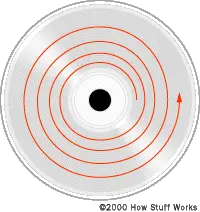
- It has been divided into tracks and sectors
- Distance between each track is 1.6 micron
- It store the data’s in pits and land
- Capacity of disk is 700mb
- Using laser beam to store the data’s into the cd While reading the data
- The rotational speed is 300 rpm
Data Read and Write Operations
- Block read is slow because it reads one small block of data from CD at one time.
- In the syncronous mode the program must be fast enough to store the data at the same speed as the CD-ROM gives it.
- In the CD-ROM digital data are impressed as pits and lands
CD-ROM drive components
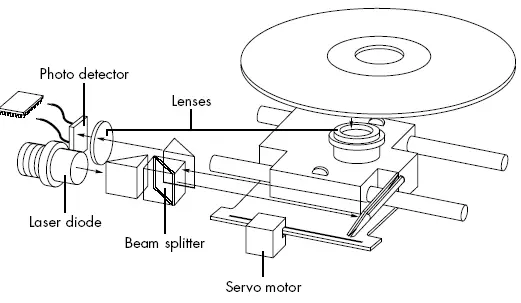
- Head
- The head provides the light on the surface of the disc and the receptor reads the reflected light.
- Head Actuator
- It is responsible for movement at right angles of head.
- Spindle Motor
- The spindle motor in hard disk drives and floppy drives have to spin the disc at a constant rate of speed.
Interface Connectors
- IDE drives are always internal devices.
- Internal CD-ROM drives have stable connectors.
- Most drives have exterior connector and a volume control.
- In the external CD-ROM drives have their own power supplies.
- Speed
- The specification of a CD-ROM is indicated by its speed like 24X, 48X, and so on.
- Interface Standard (ATAPI)
- It is an interface between the computer and attached CD-ROM drives and tape backup drives.
- Driver Configuration in real mode (DOS)
- The MS-DOS design is working through the Config.sys and Autoexec.bat files Drive maintenance
- Avoid touching the drive’s PCB, handle it by its frame
- Until the installation of the drive is complete, keep it in the packing box or antistatic bag
Common Errors and Troubleshooting
| Problem | Solution |
| Video or audio is broken up | Check the minimum speed of your software which you are using, the minimum speed should not be faster than your CD player. |
| Master Slave connection | Ensure the master is the hard drive and the slave is the CD. |
| Audio won’t work while playing the music | Make certain that the CD and the sound card are connected properly by the cable. |
| External CD not seen in boot | Port and power connection should be checked. |
| While CD works after installation, other devices do not work | Check Device Manager for this conflict |
| Error: Not enough drive letters available | You should add a line to your Config.sys that says: Last drive=x |
| Error CDR read fail 101 | The driver might not support the CD. |
CD Writter
- Cd-rw (for compact disc, rewriteable) is a compact disc format that allows repeated recording on a disc.
- The cd-rw format was introduced by Hewlett Packard,
- Mitsubishi, Philips, Ricoh, and Sony.
- Cd-rw are composed of a polycarbonate plastic substrate, a thin reflective metal coating, and a protective outer coating.
- Cd-rw discs usually hold 74/80 minutes (650/700mb) of data, and can be rewritten as many as 1000 times.
Digital Video/ Versatile Disks (DVD)
- Features
- Two data layers
- Pit size
- Double sided discs.
- Improved error checking code
- Track density.
DVD:
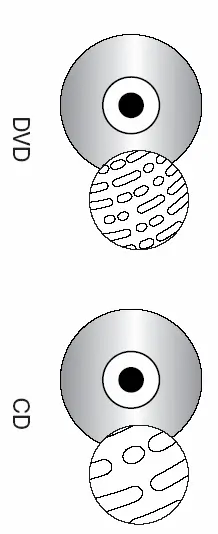
- A DVD is very similar to a CD, but it has a much larger data capacity. A standard DVD holds seven times more data than a cd.
- Data on a DVD is encoded in the form of small pits and bumps in the track of the disc.
- A DVD is composed of several layers of plastic, totaling about 1.2 millimeters thick. Each layer is created by injection molding polycarbonate plastic.
- Data track is -- just 740 nanometers separate one Track from the next (a nanometer is a billionth of a Meter.
- Audio-only DVDs that are recorded at speeds of up to 192khz and 24-bits.
DVD formats
- DVD-ROM
- VD-Video
- DVD-Audio
- DVD-RAM
- DVD Drives
- A DVD drive can read CD
- The spinning speed of the disc in DVD drives is slower than CD-ROM drives.
- The transfer rate of a DVD is very high.